When the internet first broke through the egg and pecked the datagoo from its downy wings, a lot of people (well, me at least) thought that the Web would be like a series of big rooms at a party. You’d put all your stuff in one room and play with it, and other people would come by with drinks in hand because they wanted to see and play with your stuff, and you’d have fun and get drunk and maybe accidentally sleep together, and when you wanted to check out their stuff you’d go to their room and hang out and maybe accidentally sleep with them and soon the party would be pumping and every room would be a comprehensive storehouse of one person’s presence and there would probably be fucking.
 As you can see, this metaphor does not work. Although the internet is full of rooting, that much is true.
Instead the internet has become more like a network of swingers’ parties, where you leave a set of your keys in bowls across your suburb and okay fine I’ll stop with the inappropriate metaphors, spoilsports.
But yeah, the notion of the one-stop portal or the one site where you have your presence and that everyone comes to is pretty much cactus these days. Instead our presence is balkanised, divided up into manageable, focused portions that do a specific thing and hopefully do it well. When I set up this site, I wanted it to be the hub of that online presence, and it’s serving pretty well as that, but I can also be found in a bunch of other social media/commentary sites, in case you wanted to stalk me. And you know, I’m okay with that, so long as you’re the kind of stalker who buys their target a beer rather than cuts their feet off.
Please don’t cut my feet off.
So anyway, I’ve been thinking a lot about the way we spread ourselves over the internet as I work on The Obituarist, and decided to do a run-down of the various places I’ve left a notable footprint. This is where I am:
- Here. Duh.
- LiveJournal – I blog as artbroken over there, and back in the day I used to blog a lot. Like once a day minimum since 2002. But the old grey mare she ain’t what she used to be; LJ started to fall apart under the weight of mismanagement and ugg boot spam, everyone pissed off to Facebook and I stopped being so goddamn angry all the goddamn time. Now I post something there about once a month, usually about gaming, negativity or why I don’t post much to LiveJournal any more.
- Facebook – Of course I’m on Facebook. Everyone’s on Facebook. It’s practically mandatory. These days I mostly use it to help coordinate social events, pimp blog posts, check in with what my wife and a few friends are doing and post the very occasional cool link. I keep feeling like I’m doing something wrong, and it could be so much more if I let it. But stuff that.
- Google + – I was a fairly early adopter, and like some early adopters I keep wondering if I should go back to the orphanage and see if they have a smarter kid lying around. G+ seems to be a Facebook alternative without the depth of social tools or significant audience, and all I ever post there is links back to posts I make here. Maybe one day it’ll shed its cocoon and become a beautiful butterfly.
- Twitter – Man, I fucking love Twitter. I dragged my feet over getting onto it for the longest time, and since then I’ve racked up like 6500 tweets in two years. It’s a great place to explore brevity, for one thing; it’s about communicating effectively in a small space, stripping out detail to develop nearly glyphic forms of text. Or to dump links and make smartarse comments about politicians.
- Amazon – I have an author page there, which has information on Hotel Flamingo, Godheads and a bunch of RPGs that don’t provide me with any royalties. But I can’t find it in my heart to let them go. The Amazon page is barebones, but if people leave positive reviews on things, that might bulk it out. Hint freakin’ hint.
- Smashwords – I have an author page here too, with links for the ebooks and the various free stories up there. It doesn’t compare visually to the Amazon page, but there’s more of my own stuff to read.
- Goodreads – Aaaaand I got an author page here too. Although I don’t sell any stuff through the site, so it’s mostly just a feed from this blog and a general request to please god help a brother out with some reviews and recommendations, pretty please man I need this homes.
- LinkedIn – I really don’t know why I’m on here. I’ve never done anything through the site, and mostly get contacted by people I barely know who seem to just want to professionally network for the sale of professional networking, rather than because they genuinely want to forge business/editing connections. But hey, maybe one day it’ll pay off.
- Flickr – I have some photos here. They’re pretty old.
- RPGnet – I go there to talk about roleplaying. Which I used to do a lot, back when I was writing RPGs and had more spare time and was generally much grumpier. Now I just pop up occasionally to say something semi-constructive and then vanish again, leaving only the links in my signature block.
- Obsidian Portal – Ooh, such a spooky name! This is where I write about my D&D game. If that doesn’t interest you much, I understand. If it does, go check it out. We have session writeups and a pretty detailed wiki.
That’s about it, I think, other than the various banks and online stores that make posthumously cleaning up someone’s online identity traces such a chore. If Kendall Barber was obituarising me I think it’d be fairly straightforward. And a bit freaking meta.
How about you? How thinly is your identity butter spread across the crispy toast of the internets? Where do you pitch your tent online? And do you have any stories about good ways to use LinkedIn or G+? ‘Cos I’m struggling with them, I really am.
 Or, to be more accurate, just me talking quickly about a few good things, much like I keep meaning to do with those Thursday night posts. Which are going to become Wednesday night posts, because people keep asking me to hang out and do stuff on Thursdays.
 In celebration of the MCR gig, I also reread Gerard Way’s two Umbrella Academy collections, which are surreal and occasionally disturbing superhero comics that drench pop art in Grand Guignol and outright silliness. I hope he eventually does a third series, or alternatively makes good on his promise to write a Danger Days title.
 One thing I’m excited about right now is

 A new office chair: Well, technically I got two new office chairs from my wife, because the height controls on the first one stopped working after two days, and we had to replace it lest I be left typing with my head level with the PC’s keyboard. But fortunately the folks at Officeworks were very understanding and replaced it with an even better make & model for the same price. Obviously the main thing I do at my computer is writing, and over the last few months, as my old chair fell apart and became awkward and uncomfortable to sit in, I came to realise how important a solid, comfortable chair is for sitting and writing for long periods, or even short periods. I’m not saying that all of my lower-than-acceptable 2011 writing output can be blamed on my old chair, but it’s not here to defend itself, so yeah, it’s all about the chair.
 Locke & Key Volume 2: I’ve waxed rhapsodic about this stellar comics series before, and that was just based on the first collection. Now I have the second, and will be reading it tomorrow while hooked up to a platelet extractor at the blood bank for a couple of hours. The interesting point about this title is that author Joe Hill is best known for his prose work, the horror novels Heart-Shaped Box and Horns and the anthology Ghosts. L&K is his first foray into comics, but he doesn’t write it as if it was prose, as too many novelists or scriptwriters do (and yes, I mean J. Michael Straczynski), with an emphasis on captions, expository text and dialogue. Instead, Hill lets the artist do what he needs to do, to lay down visual information and structure so that dialogue and captions add depth and meaning, the two parts working together to tell the story. It’s wonderful stuff, it’s great craft, and it’s a reminder that different forms require different approaches.
 Batman: Whatever Happened to the Caped Crusader? Yes, another graphic novel, but this one was signed by author Neil Gaiman when he did a presentation at the State Library a couple of weeks ago. There are a few takeaways here. There’s the primarily metatextual nature of the story (it’s at least as much a comic about Batman comics and Batman’s place in pop culture as it is a comic about Batman), and as we know I’m kind of a fool for metatext and stories about stories. There’s the fact that a fictional character can gain and develop so much recognition and complexity over time that a comic about his place in pop culture can actually work as a narrative. And, of course, the point that Gaiman is so successful as a writer that he now spends far more time talking about his writing than he does actually writing. Much like me. Sort of.
 The Marriage Plot: I had requested this new Jeffrey Eugenides novel at the local library, but I was 15th in the queue, which is more interest in one novel than I’ve ever seen there before. It’s refreshing to see that much demand for a non-Stephen King, non-Twilight novel. There’s always doom and gloom out there about declining reading rates and the death of literature and wah wah wah, but the truth is that there is a real and thriving market for literary fiction and for rich writing. It needs work and luck to get attention, sure – I doubt so many people would have read Middlesex if it hadn’t won the Pulitzer – but once you find that audience, you keep that audience, and it’s hungry for more of your work. I know I sure as hell am.
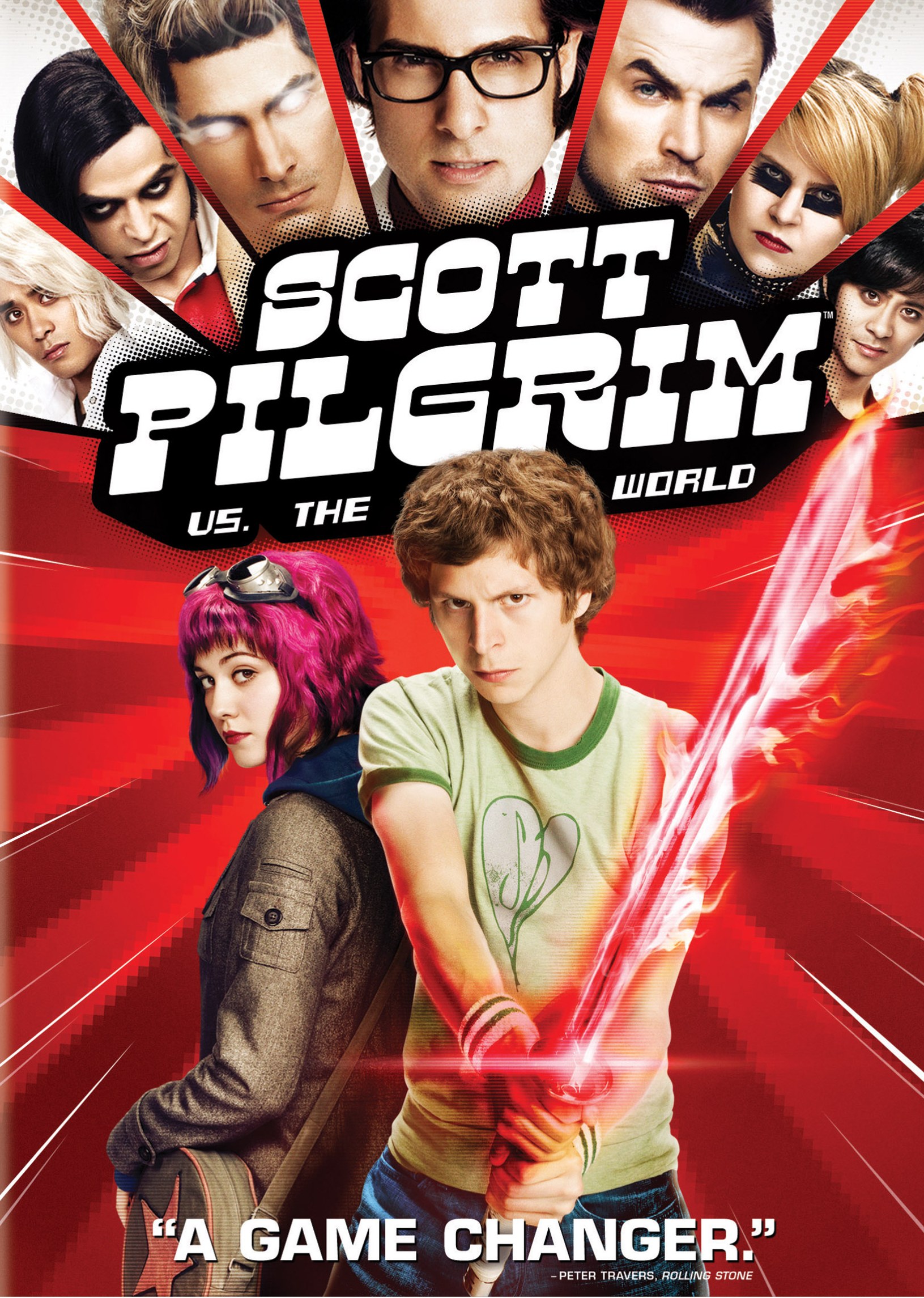 Scott Pilgrim Versus the World (DVD): It was a fun movie that deserved more attention, the cast was great (especially Chris Evans, which was unexpected) and I plan on both watching it again and lending it to friends that haven’t seen it. And yet, the important thing is that the original series of graphic novels had a great deal more complexity and depth, not to mention much more consistent pacing and character development. Like I said above, different forms require different skills and approaches, and adapting a work from one medium to another is a difficult task. Something is always lost, and in return something is (hopefully) gained. I think that, on the whole, Scott Pilgrim lost more than it gained in the transition – but then again, nothing was lost, because the graphic novels are still there. So it’s a lesson in the difficulties of adaptation, but also in the fact that the original work endures.
 A flashing d20: It lights up and flashes when you roll a 20. FUCK. YEAH. That’ll put the fear of god into the players in my 4E D&D Eberron campaign, which I want to get back to on a more frequent basis in 2012. Is that relevant to writing? Well, yeah – roleplaying doesn’t help your writing per se, but it’s a great way to hone and develop storytelling skills like pacing, plotting and characterisation.
 A bottle of Wild Turkey American Honey bourbon liqueur: Yeah, okay, I’m just gonna drink this. And I’m gonna really enjoy it.
 Really, our cat is sick. Graeme Riley, Ace of Cats –
 There’s this podcast,


